
The Ultimate Guide to User Stories in Agile Development.
User stories are a cornerstone of modern Agile methodologies, replacing complex requirement documents with a focus on simplicity, collaboration, and immediate user value.

(A diverse Agile team collaborating and arranging user story sticky notes on a shared board.)
In Agile development, delivering value to users quickly and efficiently is the top priority. One of the most effective tools used by Agile teams to capture user needs and requirements is the user story. Instead of lengthy requirement documents, Agile teams rely on simple, clear, and collaborative descriptions of features that focus on user value.
User stories help teams understand who the user is, what they need, and why they need it. They are widely used in frameworks like Scrum and help product owners, developers, and stakeholders stay aligned throughout the development process.
In this guide, we will explore what a user story is, why it is important, the user story template, and several user story examples that Agile teams can use to build better products.
What Is a User Story?
A user story is a short, simple description of a feature or requirement from the perspective of the end user. It focuses on the value the feature provides rather than technical details.
User stories are typically written in everyday language so that everyone on the team—including developers, testers, product owners, and stakeholders—can easily understand them. They are a key component of Agile frameworks such as Scrum and are stored in the Product Backlog, which contains all features and tasks required to build the product.
Note: If you are learning Scrum concepts like backlog management, sprint planning, and Agile product delivery, training programs such as the Agile and Scrum courses available on Nevolearn can help professionals build practical skills in writing effective user stories.
Why User Stories Are Important in Agile
User stories play a critical role in Agile development because they help teams stay focused on customer value. Here is why they are essential:
Encourage User-Centric Thinking: Instead of focusing on technical requirements, user stories emphasize what users actually need.
Improve Team Collaboration: Because user stories are simple and easy to understand, they encourage collaboration between developers, product owners, and stakeholders.
Enable Agile Planning: User stories allow teams to estimate work easily and plan sprints more effectively.
Support Incremental Development: Each user story represents a small unit of functionality that can be developed and delivered within a sprint.
Increase Flexibility: Since Agile projects evolve continuously, user stories make it easier to adapt to changing requirements.
The Standard User Story Template
Agile teams typically follow a simple structure when writing user stories. The most common user story template is:
As a [type of user], I want [goal or action] so that [benefit or value].
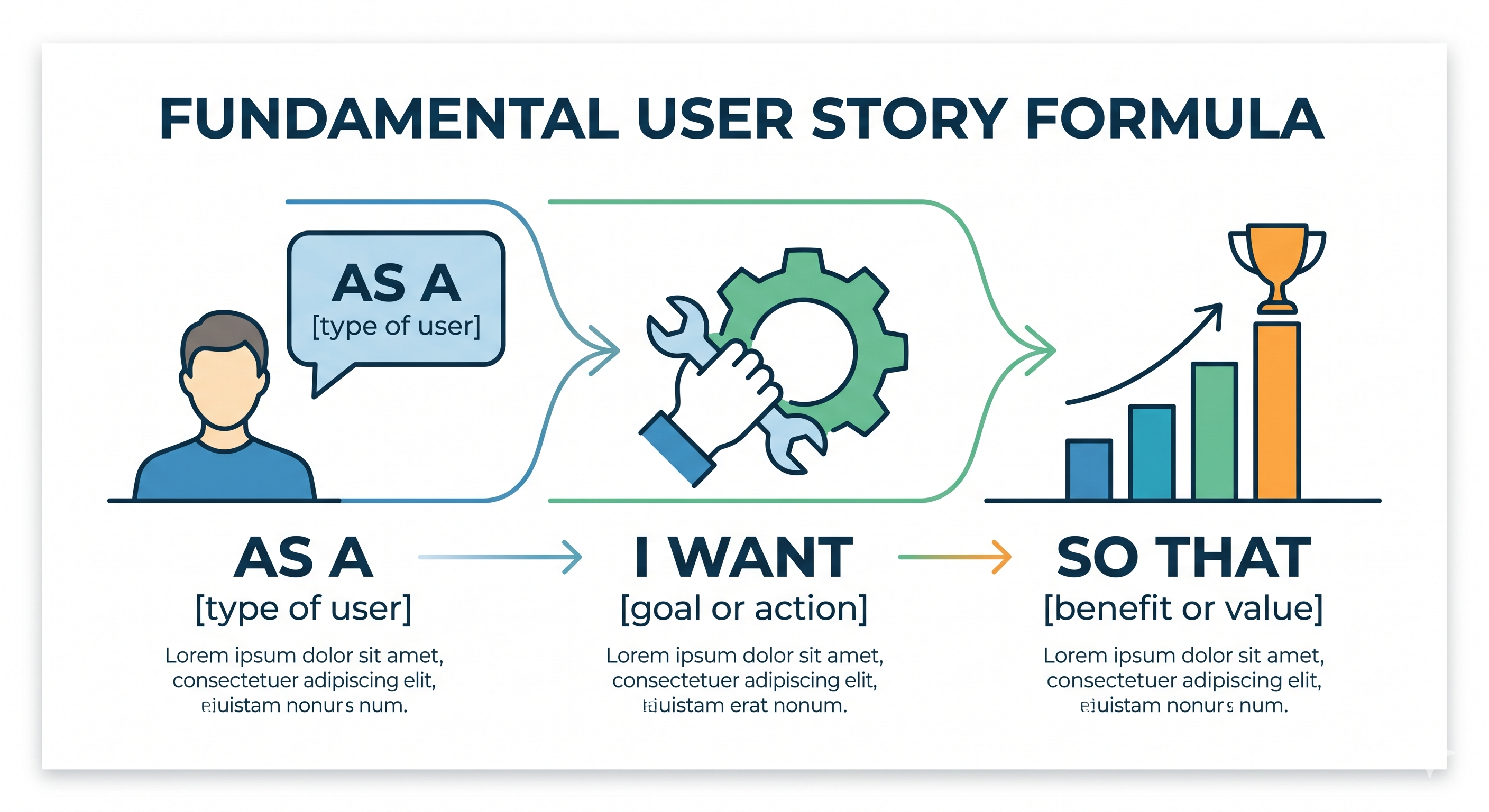
(A clear infographic illustrating the three segments of the standard user story formula.)
This format ensures that every user story clearly answers three important questions:
| Element | Meaning |
| User | Who needs the feature |
| Action | What the user wants to do |
| Value | Why the feature is important |
Example: As a customer, I want to track my order status so that I know when my package will arrive.
Components of a Good User Story
A good user story contains more than just the basic template. Agile teams usually include the following elements:
Title: A short name that summarizes the user story. (Example: Track Order Status)
Description: The user story written in the standard format. (Example: As a customer, I want to track my order status so that I know when my order will be delivered.)
Acceptance Criteria: The conditions that must be met for the user story to be considered complete.
Priority: Ranked by product owners based on business value and urgency.
Effort Estimate: The estimated complexity of implementing the story, often using methods like story points.
Real-World User Story Examples
To better understand how user stories work in real-world projects, let’s explore some practical examples across different industries.
1. E-commerce Website
User Story: As a shopper, I want to filter products by price range so that I can find items within my budget.
Acceptance Criteria:
Users can select minimum and maximum price.
The product list updates based on selected filters.
Filters can be reset easily.
2. Online Learning Platform
User Story: As a learner, I want to track my course progress so that I know how much of the course I have completed.
Acceptance Criteria:
Progress percentage is displayed.
Completed lessons are marked.
Progress is updated automatically.
3. Mobile Banking Application
User Story: As a bank customer, I want to receive notifications for transactions so that I can monitor my account activity.
Acceptance Criteria:
Notification is sent for deposits.
Notification is sent for withdrawals.
Notification includes transaction details.
4. Food Delivery Application
User Story: As a customer, I want to see restaurant ratings so that I can choose high-quality restaurants.
Acceptance Criteria:
Restaurant ratings are displayed.
Reviews are visible to users.
Ratings update dynamically.
5. Travel Booking Website
User Story: As a traveler, I want to save my favorite destinations so that I can easily book them later.
Acceptance Criteria:
Users can mark destinations as favorites.
Favorites list is accessible in the profile section.
Users can remove items from favorites.
Characteristics of Effective User Stories (INVEST)
Good user stories follow a set of principles often referred to as INVEST.
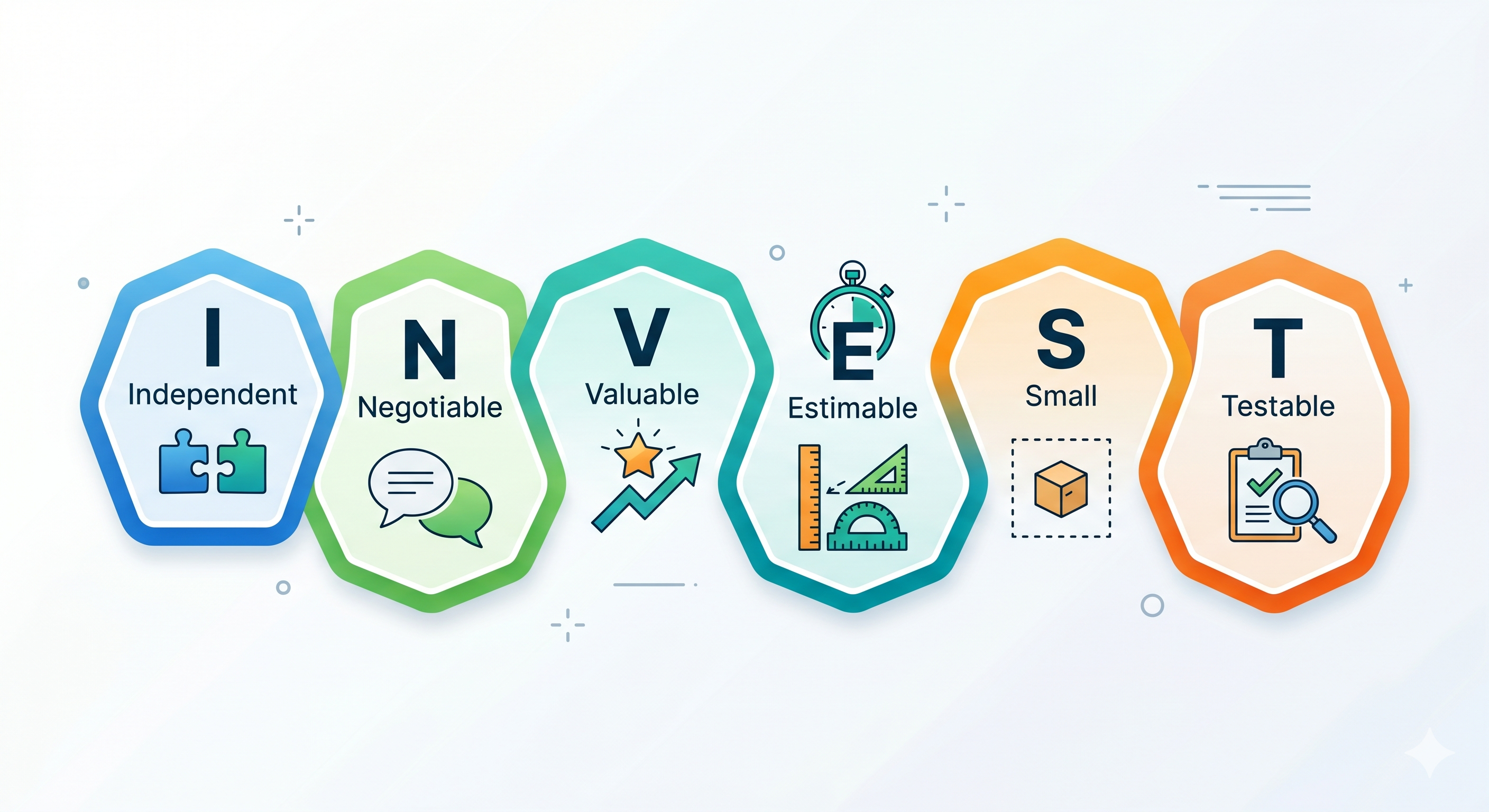
(An elegant infographic detailing the INVEST mnemonic (Independent, Negotiable, Valuable, Estimable, Small, Testable) for effective user stories.)
Independent: User stories should be independent so they can be developed separately.
Negotiable: They should encourage discussion and collaboration rather than being fixed requirements.
Valuable: Each story must deliver value to the user.
Estimable: The development team should be able to estimate the effort required.
Small: User stories should be small enough to complete within a sprint.
Testable: Each story should have clear acceptance criteria to verify completion.
Best Practices & Common Mistakes
Writing effective user stories requires clarity and collaboration. Keep these dos and don'ts in mind.
Best Practices
Focus on User Value: Always emphasize how the feature benefits the user rather than describing technical implementation.
Keep Stories Simple: Avoid overly complex or lengthy descriptions.
Collaborate with the Team: User stories should be discussed and refined during backlog refinement sessions.
Define Clear Acceptance Criteria: Clear criteria help avoid confusion during development and testing.
Break Large Stories into Smaller Ones: Large user stories, often called epics, should be divided into smaller stories that fit within a sprint.
Common Mistakes
Writing Technical Tasks Instead of User Needs: (e.g., “Implement database API for login module.”) This focuses on technical work instead of user value.
Missing Acceptance Criteria: Without clear acceptance criteria, teams may not know when the story is complete.
Stories That Are Too Large: Large stories make sprint planning difficult and increase development risk.
Lack of Collaboration: User stories should be discussed with developers, testers, and stakeholders to ensure clarity.
How User Stories Fit Into the Scrum Process
User stories are typically stored in the Product Backlog, where the Product Owner prioritizes them based on business value.
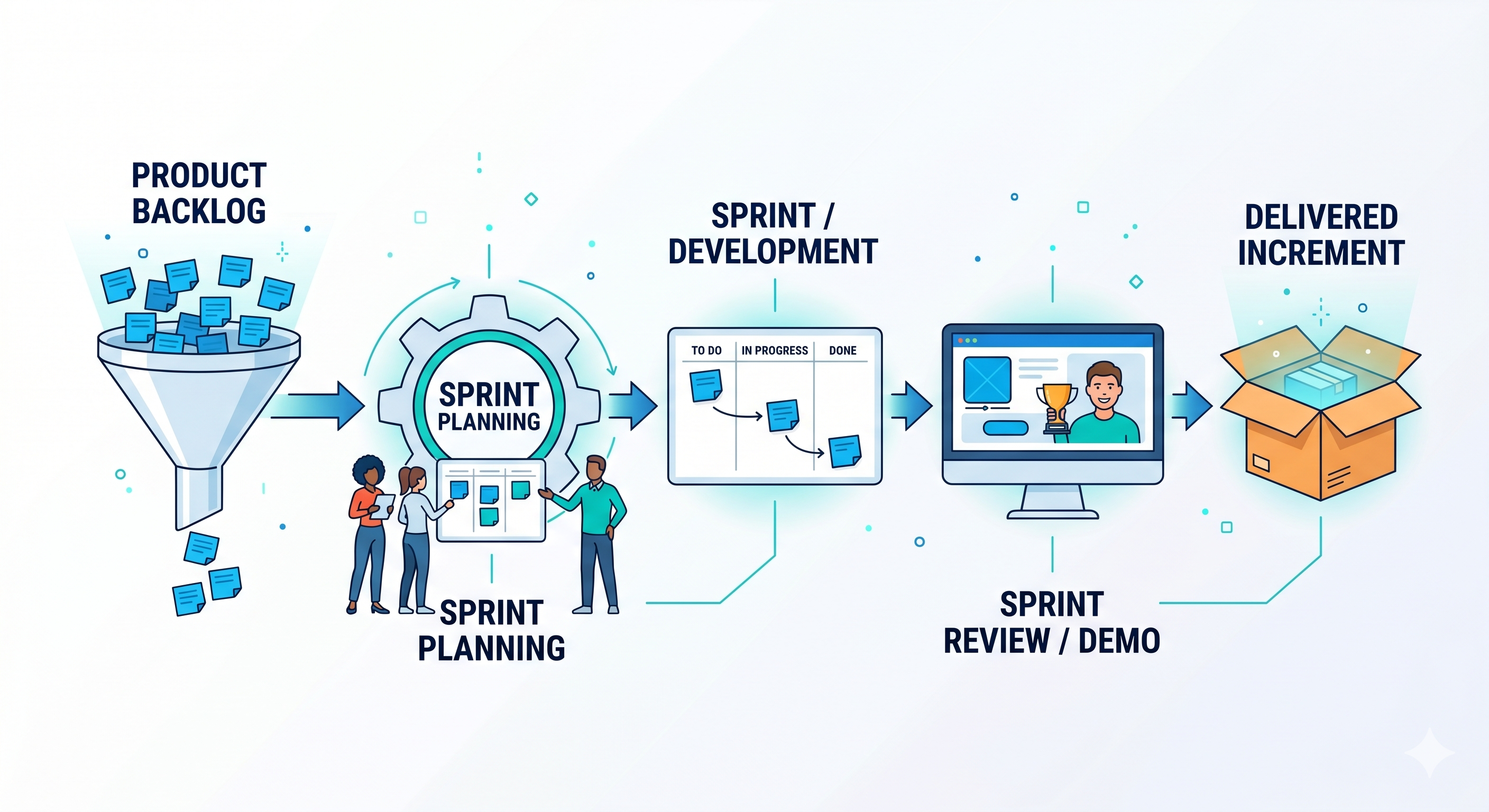
(A process flowchart moving a user story from the Product Backlog, through Sprint Planning and the Development Sprint, to the final Delivered Increment.)
During Sprint Planning, the team selects user stories that can be completed within the sprint. The development team then works on these stories, and once completed, they are included in the product increment delivered at the end of the sprint. This process ensures that teams deliver incremental improvements to the product in every sprint cycle.
Conclusion
User stories are a powerful tool that helps Agile teams deliver products that truly meet user needs. By focusing on user value, encouraging collaboration, and supporting incremental delivery, user stories simplify the product development process.
Using a structured user story template and well-defined acceptance criteria helps teams build clear, actionable requirements. Real-world user story examples further demonstrate how this approach can be applied across industries such as e-commerce, banking, education, and travel.
As Agile adoption continues to grow across organizations worldwide, mastering the art of writing effective user stories has become an essential skill for product owners, Scrum Masters, developers, and project managers. By applying the best practices discussed in this guide, teams can create user stories that improve product quality, enhance collaboration, and deliver real value to users.


