
The Complete Guide to the 3 Roles in Scrum 🚀
Scrum has become one of the most widely adopted Agile frameworks for managing complex projects, especially in software development, product management, and digital transformation initiatives. Its simplicity and flexibility allow teams to deliver high-quality products in short cycles while continuously adapting to change.
Here is an image illustrating the unique dynamic of an Agile Scrum team in action.

(A diverse, cross-functional Agile team collaborating around a physical task board to plan their next sprint.)
At the heart of the Scrum framework lies a clearly defined team structure. Many beginners often ask, “A Scrum team consists of which 3 roles?” The answer is simple: Scrum operates with three key roles, each responsible for specific aspects of product delivery and team collaboration.
The 3 roles in Scrum are:
Product Owner
Scrum Master
Development Team (Developers)
These three roles work together to ensure transparency, efficient collaboration, and continuous delivery of valuable product increments. In this guide, we will explore these roles, their responsibilities, the skills required, and how they collaborate to create high-performing Agile teams.
What Are the 3 Roles in Scrum? 👥
The Scrum framework intentionally keeps the team structure simple to reduce hierarchy and encourage collaboration. Each role focuses on a different aspect of the project:
| Role | Primary Focus |
| Product Owner | Maximizing product value and managing the backlog |
| Scrum Master | Facilitating the Scrum process and removing obstacles |
| Development Team | Delivering working, high-quality product increments |
Together, these three roles form a cross-functional and self-organizing team capable of delivering value in every sprint.
1. The Product Owner 🎯
The Product Owner is responsible for maximizing the value of the product being developed by the Scrum team. They act as the bridge between stakeholders, customers, and the development team. The product owner ensures that the team works on the most valuable features first, helping organizations deliver meaningful outcomes quickly.
The following unique image captures a Product Owner prioritizing the product backlog using advanced digital tools.

(A Product Owner analyzing business value and prioritizing features in a digital product backlog.)
Key Responsibilities
Managing the Product Backlog: Creates and maintains the prioritized list of product features, enhancements, and bug fixes.
Defining Product Vision: Communicates the long-term vision of the product to the Scrum team and stakeholders.
Prioritizing Work: Decides which backlog items should be completed first based on business value, market needs, and customer feedback.
Stakeholder Communication: Regularly interacts with customers, business leaders, and other stakeholders to ensure alignment.
Accepting Completed Work: Evaluates completed work during sprint reviews and confirms whether it meets acceptance criteria.
Skills Required
Successful product owners typically possess:
Strong business understanding and market awareness.
Product management skills.
Communication and stakeholder management abilities.
Decision-making capability.
2. The Scrum Master 🛡️
The Scrum Master is the facilitator and servant leader of the Scrum team. Their primary responsibility is to ensure that the team follows Scrum principles and practices effectively. Unlike traditional project managers, the Scrum Master does not control the team or assign tasks. Instead, they guide the team in adopting Agile practices and removing obstacles that slow down progress.
Here is a look at a Scrum Master facilitating a Daily Scrum, protecting the team.

(A Scrum Master acting as a servant-leader, shielding the team from distractions and facilitating a Daily Scrum.)
Key Responsibilities
Facilitating Scrum Events: Ensures all Scrum ceremonies (Sprint Planning, Daily Scrum, Sprint Review, Sprint Retrospective) run smoothly.
Removing Impediments: Resolves obstacles quickly when they affect team productivity.
Coaching the Team: Helps the team become more self-organized and efficient in their Agile practices.
Protecting the Team: Shields the team from unnecessary distractions and external pressures during a sprint.
Promoting Agile Culture: Helps the broader organization embrace transparency, collaboration, and continuous improvement.
Skills Required
To be effective, a Scrum Master should have:
Deep understanding of Agile and Scrum principles.
Strong leadership, coaching, and mentoring abilities.
Conflict resolution and excellent communication skills.
3. The Development Team (Developers) 💻
The Development Team is responsible for delivering the actual product increments. They are a group of professionals who collaborate to design, build, test, and deliver product features during each sprint. The team is cross-functional, meaning it includes members with all the different skills required to complete the work.
This unique visualization emphasizes the focused collaboration that is central to a high-performing Development Team.

(A cross-functional group of Developers collaborating on a complex problem to deliver a product increment.)
Typical Roles Within the Development Team
Depending on the project, the team may include Software Developers, QA Engineers, UI/UX Designers, DevOps Engineers, Data Engineers, or Business Analysts. However, in Scrum, all of them are collectively called Developers.
Key Responsibilities
Delivering Product Increments: Builds and delivers a working product increment at the end of every sprint.
Self-Organization: Decides how to complete the work without external supervision.
Sprint Planning Participation: Estimates tasks and commits to work they can complete during the sprint.
Maintaining Quality: Ensures that all work meets the Definition of Done before being considered complete.
Characteristics of an Effective Team
High-performing Scrum teams demonstrate cross-functional skills, accountability, seamless collaboration, continuous learning, and strong technical expertise.
How the 3 Scrum Roles Work Together 🤝
Although each role has specific responsibilities, they must collaborate closely to achieve sprint goals:
Product Owner + Development Team: The PO defines what needs to be built, while the Developers decide how to build it.
Scrum Master + Development Team: The Scrum Master supports the Developers by removing obstacles and ensuring the process runs smoothly.
Scrum Master + Product Owner: The Scrum Master helps the PO manage the backlog effectively and improve stakeholder collaboration.
Check out this modern visualization of the interconnected roles.
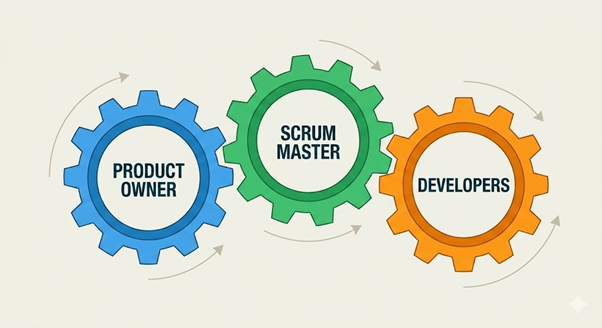
(A clean, modern diagram showing three interlocking gears representing the Product Owner, Scrum Master, and Developers working in sync.)
Scrum Team Size and Structure
A typical Scrum team consists of 10 or fewer members, including all three roles. Small teams are preferred because they:
Improve communication.
Reduce complexity.
Enable faster decision-making.
Increase productivity.
(If a project requires more people, organizations usually create multiple Scrum teams that work on different components of the product.)
Benefits of Clearly Defined Scrum Roles
Creating clarity and accountability within Agile teams leads to significant advantages:
Better Product Focus: The team works on features that bring the highest value to users.
Improved Team Productivity: Obstacles are consistently removed, and processes are optimized.
Higher Product Quality: The focus remains on delivering working, tested product increments each sprint.
Faster Delivery: Clear responsibilities allow teams to ship features to market faster.
Common Mistakes Teams Make with Scrum Roles ⚠️
Despite its simplicity, organizations sometimes misuse Scrum roles:
Treating the Scrum Master as a Project Manager: The Scrum Master is a facilitator, not a traditional manager assigning tasks.
Multiple Product Owners: Scrum works best when there is one clear PO responsible for backlog decisions.
Lack of Team Autonomy: Development teams should be self-organizing rather than controlled by external stakeholders.
Ignoring Agile Principles: Simply assigning titles without genuinely following Scrum practices does not guarantee success.
Conclusion
The 3 roles in Scrum—Product Owner, Scrum Master, and Development Team—form the backbone of the Scrum framework. Each role plays a unique and essential part in ensuring that the team delivers valuable products efficiently:
The Product Owner defines product priorities and vision.
The Scrum Master facilitates the Scrum process and supports the team.
The Development Team builds and delivers working product increments.
When these three roles collaborate effectively, teams can adapt quickly to change, deliver high-quality products, and continuously improve their processes. Whether you are a developer, project manager, or business analyst, mastering the dynamics of these roles is an essential skill for succeeding in modern Agile environments.


